


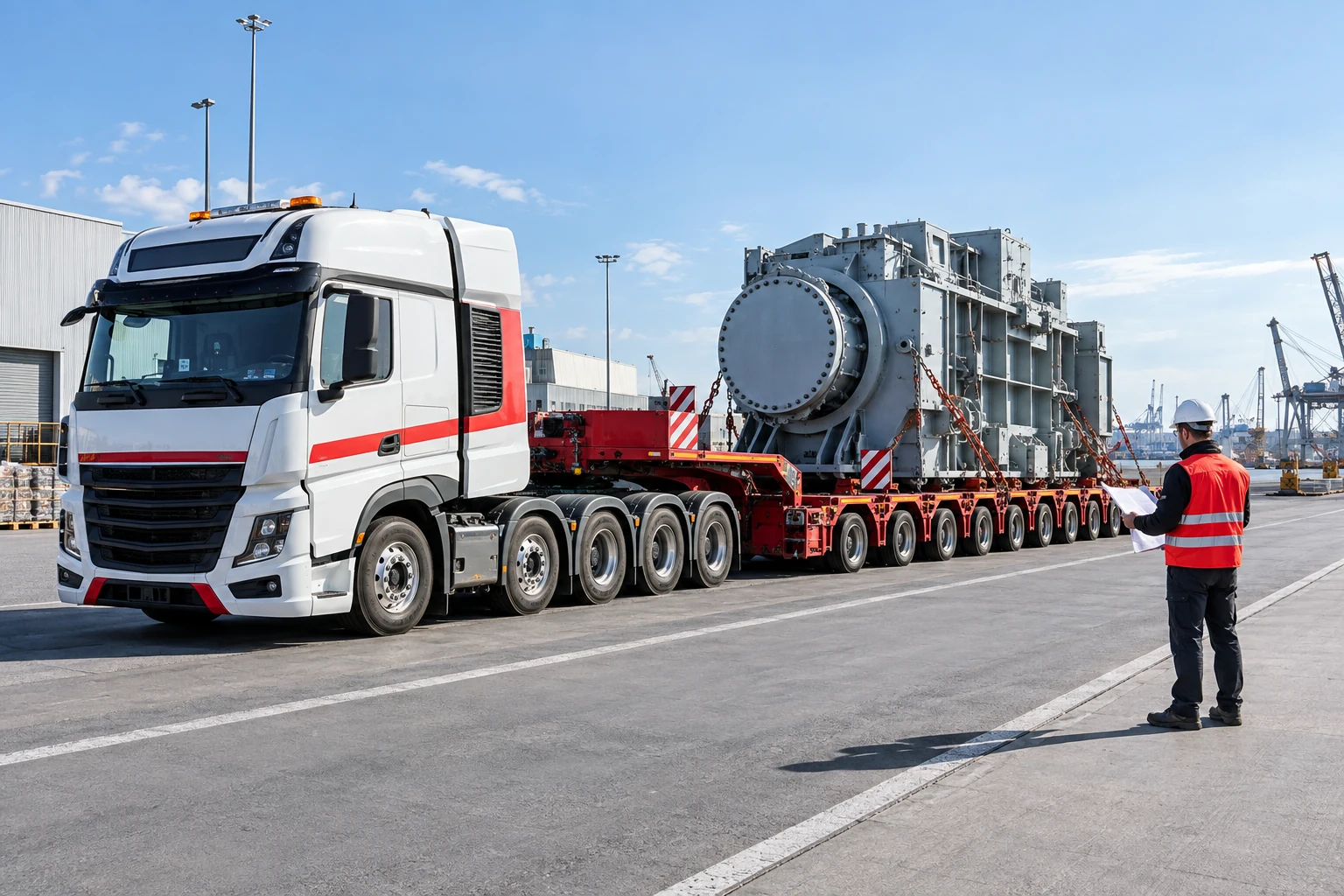
Planning a Successful Heavy-Haulage Project
Heavy-haulage transport demands far more engineering and coordination than a standard delivery. Assessing every detail in advance, from load dimensions to route restrictions, is key to a safe and timely arrival.
Begin with load analysis
Establish the load’s weight, length, width, height and center of gravity. Identify lifting points and sensitive areas so that the right trailer, axle configuration and securing method can be selected.
A route survey is more than a distance calculation
Bridge clearances, road widths, turning radii, gradients, overpasses and site entrances all form part of route planning. Where necessary, develop alternative routes and plan measures for critical crossing points.
The shortest route is not always the best; safe passage and maneuvering space take priority.
Choose the right vehicle and axle distribution
The tractor’s power, trailer type and number of axles should match the load. Balanced axle distribution helps control both vehicle handling and the load imposed on road surfaces.
Secure the load and coordinate the operation
Choose securing equipment with the possible directions of load movement in mind. The driver, site team, escort personnel and lifting crew should follow the same operational plan. Loading and unloading times are integral to the transport schedule.
- Prepare loading and unloading areas in advance.
- Monitor weather and traffic conditions.
- Designate a communication lead for critical crossings.
- Check securing points regularly throughout the journey.